
The advantages & benefits of Building with Timber
International research and experience show that fire resistance, structural integrity, speed of construction, safety, cost and economic benefits, and environmental attributes make new multi-storey mass timber buildings among the most innovative structures in the world. The aesthetic, biophilic, and other benefits of using wood offer market appeal that can lift a building’s value.
-
The government has passed legislation committing New Zealand to being net zero in climate change emissions by 2050 (Zero Carbon Act).
A report by Thinkstep shows that the construction and operation of buildings are responsible for around 20% of our domestic emissions. About half of these emissions come from construction in concrete and steel, which both have high levels of embodied carbon. This is because steel and concrete require large amounts of fossil fuel energy for their extraction, the chemical manufacturing process and in their transport.
The role of forestry and locally manufactured wood products in mitigating climate change includes:
Sequestering CO₂ from the atmosphere through forests
Reducing the emission of 10% of embodied carbon in buildings
Forecasting by Deloitte indicates that changing market share to wood by 25% would result in 920,000 tonnes of CO₂ being sequestered annually.
Research by the University of Canterbury, Victoria University and Scion helped establish that New Zealand could become carbon neutral in building structures if wood’s market share increased by 67% instead of 25%.
-
Both steel and concrete each account for an estimated 5% of embodied CO₂ emissions globally. Worldwide steel production currently totals about 1.5 billion tonnes per year. CO₂ emissions of each building material are calculated by the energy source used in manufacturing, and transportation mileage. Average emissions per tonne are:
Steel - 1.9 tonnes of CO₂
Concrete - 0.45 tonnes of CO₂
By contrast, 1 tonne of wood sequesters 1.7 tonnes of CO₂
The construction industry is a large contributor to CO₂ emissions. In Europe, buildings are responsible for 40% of total energy consumption and a third of CO₂ emissions.
According to the Intergovernmental Panel on Climate Change (IPCC) and the United Nations Environment Programme (UNEP) Sustainable Building and Construction Initiative (SBCI), buildings have the largest estimated economic mitigation potential for emissions reduction (both embodied and operational), among the sector solutions investigated.
When replacing concrete and steel with wood, the net CO₂ benefit compounds because wood prevents emissions while creating sequestration. This compounded benefit can be seen in the graphic further down the page.
-
In a fire, mass-timber chars on the outside while retaining strength, slowing burning and allowing time for occupants to evacuate. Mass-timber is predictable when exposed to fire. Testing by North American engineers and building research institutions and their New Zealand counterparts has shown that a 17.8cm thick wall of CLT typically lasts for over 3 hours.
Performance is enhanced by using non-combustible claddings, new glues and fastenings design. All buildings can experience a fire, but modern fire sprinkler systems will usually contain an outbreak to a single space.
-
High strength-to-weight ratios enable mass-timber to perform well during earthquakes. Recently constructed mass-timber buildings weigh approximately 20% less than comparable steel and concrete buildings. That reduces foundation size and cost, inertial seismic force and embodied energy.
-
Mass-timber and prefabrication accelerates the building of mid-rise accommodation, particularly entry-level and social housing, and others such as education and health facilities. This is because the speed and scalability of production and erection using mass-timber materials is 25 - 30% faster and is less complex than steel and concrete according to international and New Zealand engineers.
-
The benefits of mass-timber and prefabrication include reducing construction waste and noise, as well as reducing workplace injuries, traffic disruption and carbon dioxide emissions from construction vehicles and machinery.
-
International research has found that nature-connected (biophilic) design, which includes extensive use of wood, results in:
Office design – productivity increased by 8% and rates of well-being increased by 13%
Education spaces – increased rates of learning, improved test results, concentration levels and attendance, and reduced impacts of ADHD
Healthcare spaces – post-operative speed of recovery reduced by 8.5%, and reduced pain medication by 22%
International research has found that nature-connected (biophilic) design, which includes extensive use of wood, results in:
Office design – productivity increased by 8% and rates of well-being increased by 13%
Education spaces – increased rates of learning, improved test results, concentration levels and attendance, and reduced impacts of ADHD
Healthcare spaces – post-operative speed of recovery reduced by 8.5%, and reduced pain medication by 22%
-
A rise in the use of mass timber will support existing and new jobs, from forests to saw milling, engineered wood manufacturing sites, prefabrication plants and ports. These enterprises are spread throughout New Zealand’s regions.
Research by Deloitte helped establish that if wood’s market share increased by 25% across all building types, it could generate demand for over 1.5 million m³ of wood products annually.
It estimated that this would generate at least 4,800 plus jobs across the forest industry value chain, including:
1,000 high-value wood processing jobs
750 forestry, transport and port jobs
3,050 indirect support jobs
Adding this increase to the 38,500 positions already in the sector would bring the total to just over 40,000 direct jobs.
While a 25% market share increase for wood could impact those currently employed in the steel and concrete supply chains this would likely be offset by increased employment associated with the use of steel and concrete in the large horizontal infrastructure projects that are planned. In addition, there will always be a need for these products for foundations and in hybrid mass timber, steel and concrete structures and the demand for fabrication of steel connections between mass timber members would increase.
-
A 25% market share for wood would provide the economies of scale and cost base for New Zealand wood processors to compete better internationally.
Below is a forecast of the additional annual exports this could generate.
Mass timber products generate the highest returns.
Approximately 523,000 tonnes of additional wood chips would be available from the increase in processing. These chips could be used in New Zealand’s pulp mills and open up opportunities for the use of woody biomass in fuel production.
Combined with reduced imports of steel and cement a net balance of payments improvement of $500m annually is forecast in the Deloitte research.
*See table of comparisons at the bottom of this page.

Analysing actual buildings and the amount of CO₂ that would be emitted or sequestered according to the building materials used, demonstrates the benefits of substituting steel and concrete with wood.
Below are the findings of a comprehensive 2008 study by University of Canterbury, in conjunction with Victoria University of Wellington and Scion, which analysed a 6-storey 4,200m² building.
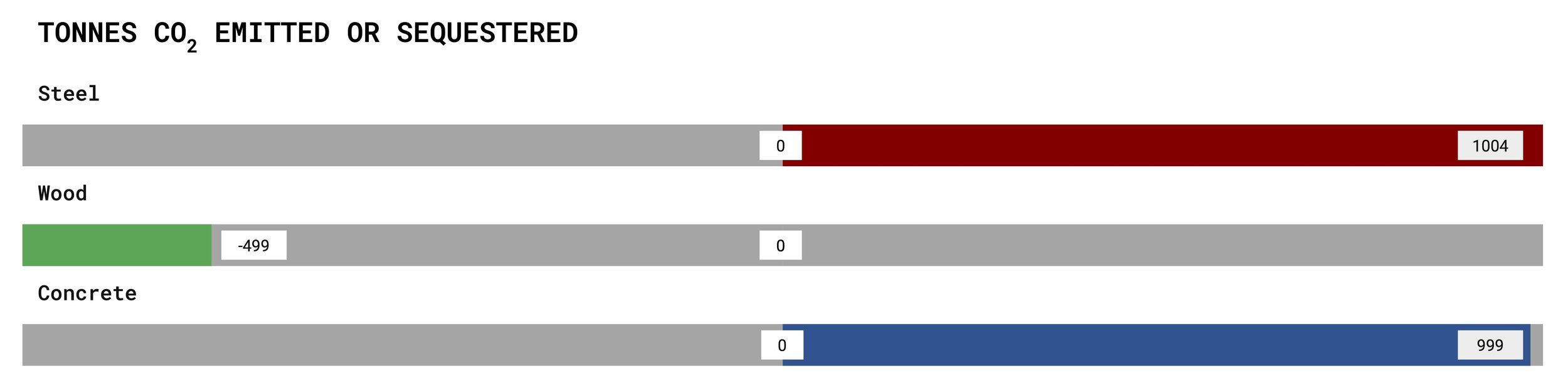
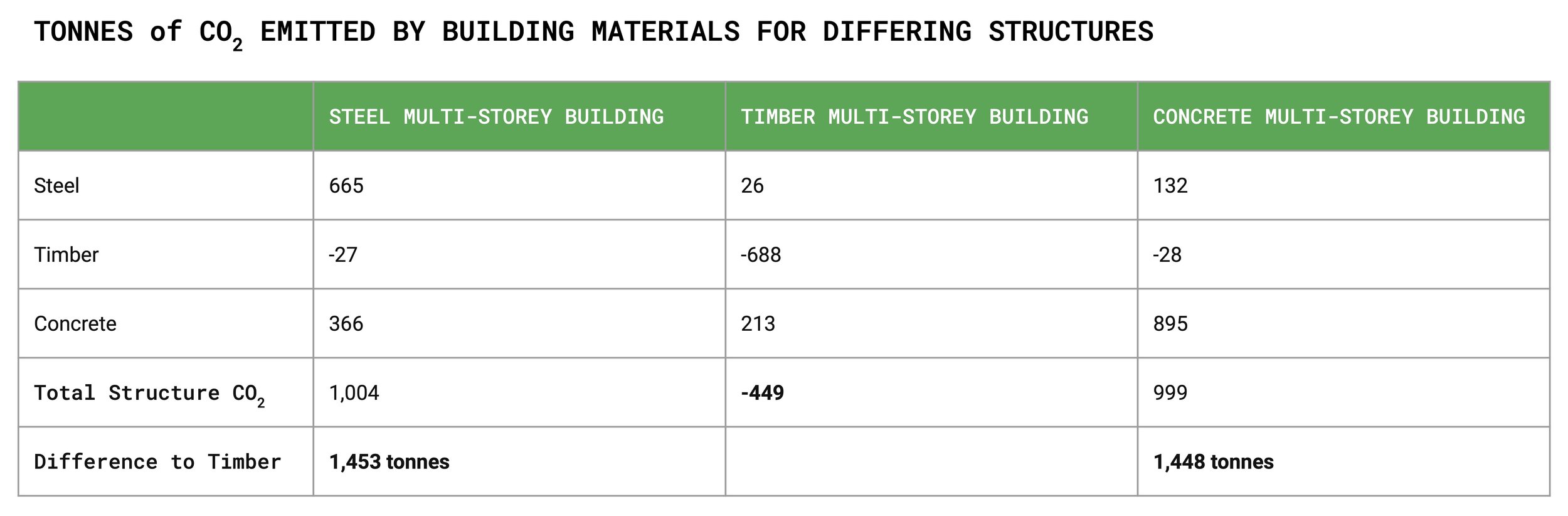
The CO₂ emissions saved from using wood instead of steel and concrete is 0.34 tonnes (340 kg) of CO₂ per m² of floor area.
Cost
Two examples of cost comparisons between the use of mass-timber, and steel and concrete show that buildings constructed of all materials are similar.
Classroom blocks
Ministry of Education classroom blocks were used for comparison. The main structural material used in the design was heavy gauge steel imported from Asia. Logic Group - the quantity surveyor calculated how much this build would have cost using glue laminated timber. Logic’s finding was that the cost difference was “negligible” ($100 per classroom).
That $100 would be quickly offset had the Ministry factored in the speed of construction, biophilic advantages for children’s learning and CO₂ performance.
Clearwater reference building
Logic Group compared this mass timber construction building with identical designs in steel and concrete. It assessed carbon performance and costs.

*Trade
